Chile, Part 4

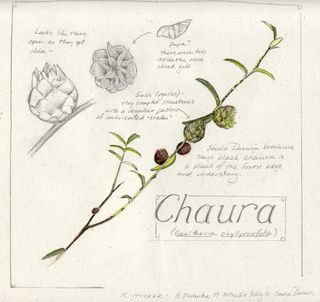
Chaurasketch2The island of Chiloe, in the south of the country, is an extraordinary place, with a highly-diverse forest, great variety of birds, and a mellow, friendly atmosphere. It was our favorite place; I'd gladly go back there  for more seafood, hiking, birdwatching, and exploring.

Chaura was one of dozens of native forest species there. It's a Gaultheria, so it's closely related to wintergreen (procumbens) and salal (shallon). I got fascinated by the beautiful galls on many of the chaura bushes, so here's my page about them.

For some photos of Chiloe (and the other parts of our trip) go to the following URL: http://www.flickr.com/photos/46117111@N05/sets/72157623005731457
Chile, Part 2

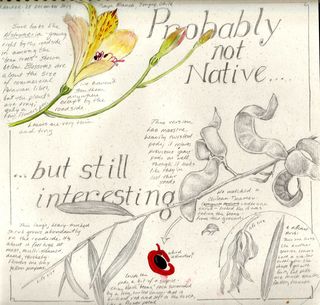
Notnativesketch2 Here are a couple of plants we found on a walk. Because they  grew in close proximity to roads and buildings, I assumed they must be introduced. But after researching them a bit, I'm  now thinking they might be more native than I had thought. There are many native Alstroemerias in Chile (although apparently most are winter-blooming), and the legume shrub looks like it could be in the Prosopis genus, which is native… in any case, I was intrigued by that odd, bright red flag on the seed. Cheryl wondered if it was a bird-attractor.

Soft Sky Day

Ravens-and-trees We've had quite a bit of snow lately, most of it falling in long, relentless storms of tiny flakes: the kind of snowstorm that softens the edges of not only the physical world but also the world of sound, and, somehow, the province of emotion.

For some reason, ravens seem to be exceptions to that blankness; their silhouettes nearly as sharp as on a clear day, their calls and the rattle of their wings as carrying, their characters as substantial. It's as if they are drawing all the world's crispness into themselves as a joke, leaving the rest of us to drift around, muffled and half-present while they chuckle.

Contorta contorta, Part 2

Twisted-pine

In my opinion, no other trees in Southeast Alaska are as suffused with sheer character as shore pines (Pinus contorta contorta). Over hundreds of years, they grow into an incredible variety of shapes, pressed and bent and corkscrewed by snow and wind and time.

Then, after they live out their multi-century lives and begin to decompose, their unique characters emerge even more strongly. Most have twisted trunks (according to a small study a friend and I did last winter, almost all trunks twist to the right). Some, like this one, twist in incredibly tight spirals, while others are more relaxed. Over time, they begin to look less like tree trunks and more like frayed and rotting ropes, their fibers gone soft and silver.

Storms of Birds

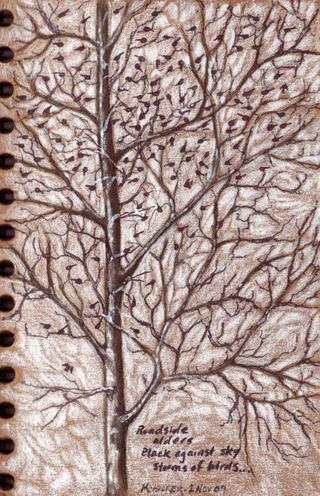
Birdstorm2 The Weather Service says we had a dry October, but that doesn't mean sunny. The days have been windswept, cold, and cloudy, for the  most part. On my walks I've been watching the tops of the leafless alders, fascinated by the pattern of dark branches against shining sky.

It all looks so cold and lifeless… and then I'll walk past another tree and hundreds of small birds (siskins and probably redpolls too) will explode from the branches and swirl into the sky. They'll eddy for a moment like a river current, then descend to clutter the branches of the next alder. Then, as I approach, they'll take off again, all in unison so that hundreds of tiny, soft wing-claps merge into a great and startling "whump".

This sketch was inspired by those patterns of branches and birds. I haven't quite got the gestures of the alder branches, but I think it captures some of that restless motion.

Yellow Pond Lily

Pond-lily1-kh

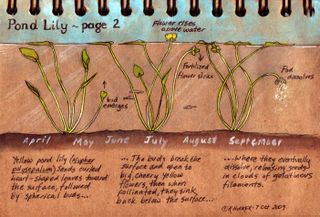
 Pond-lily2-khSpent a fair bit of time today wandering around a medium-elevation bog. Plants were about the same stage as those at sea level, though a couple of pond lilies still had underwater buds (!) This was particularly interesting, because I could see almost all of the stages of flowering at once. I had never studied their blooming cycle that closely. I was fascinated at how the pods dissolve in the still, tea-colored water of the bog ponds; I could see scatterings of seeds underneath several plants.

I always feel a little guilty picking a pond lily flower or seedpod. They're so big, and so gracefully-formed: like urns or chalices. But there were so many this summer that I'm not feeling too terrible about it. Several of my plant books say the seeds are edible and tasty. I'd say edible, perhaps borderline tasty. They're big, anyway: as big as grains of Calrose rice.

Bog Pods

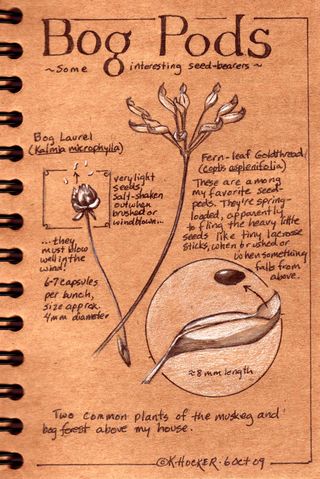
Bog-pods-kh Everything's going to seed these days… all those unpicked blueberries are bloated with rain and tasteless now, bursting and spattering their little seeds onto the vegetation below, menziesia pods drying and curling, and these two bog/wet forest plants whose seed capsules I find particularly enchanting-looking…

Oregon Trees

Oregon-trees

Traveling in Oregon now, visiting family, and it's fun to see the variety of tree shapes… Much bigger than in Alaska! These are my best guesses on species…

Contorta contorta

Shorepine-kh

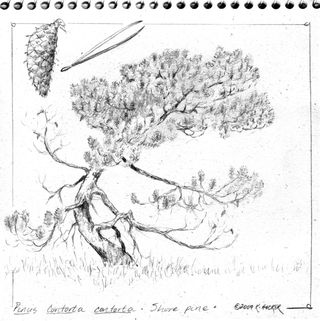
Here in Southeast Alaska, lodgepole pine (Pinus contorta) grows in its "shore pine" (P. contorta contorta) form. It's well-named: no lodgepole-straight trunks here, just endless variations of twist and turn, forced into beautiful cantilevers by countless winters of heavy snow. A shore pine with a trunk with the diameter of my arm may have 300 microscopic growth rings in its heart. I love the way the branches reach out; they offer up their clusters of needles with such grace.

Autumn Storm and Autumn Fruits

Late-berries

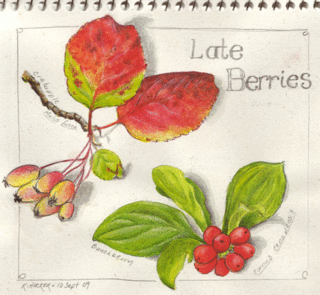
Northern Southeast Alaska was battered by a muscular Pacific storm yesterday– all eerie light and buffeting wind, with purple-gray swaths of rain hitting Stephens Passage so hard that the ocean water seemed to be jumping up to meet them in mid-air. I walked through the storm to the beach, listening to the wind moan and hiss. Collected these late fruits on the way back. Crabapples are among the few native shrubs here that show any fall color; in yesterday's wind their leaves were spinning on the branches, flashing red and orange, flying through the air like bonfire sparks. Down below, bunchberries hugged the ground, slick with rain.