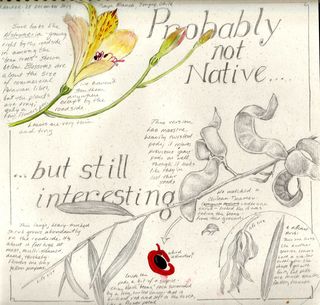
 Here are a couple of plants we found on a walk. Because they grew in close proximity to roads and buildings, I assumed they must be introduced. But after researching them a bit, I'm now thinking they might be more native than I had thought. There are many native Alstroemerias in Chile (although apparently most are winter-blooming), and the legume shrub looks like it could be in the Prosopis genus, which is native… in any case, I was intrigued by that odd, bright red flag on the seed. Cheryl wondered if it was a bird-attractor.
Chile, Part 1
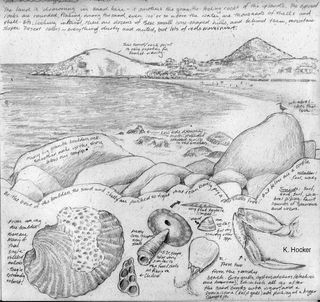 We just returned from a 3-week trip to Chile, so I’ll post the results here over the next couple of days. The first is a page from Playa Blanca, a little resort beach south of La Serena. It was a lovely spot, great for lazing around, exploring desert and coast, and sketching. Our condo unit was just above the boulder beach in the foreground here, so we were soothed by the roar of the surf day and night. At dawn, whimbrels and oystercatchers piped their calls into the wind.
Headed South
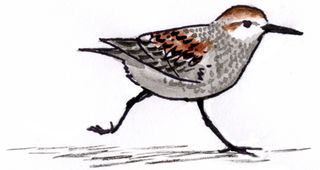 I’m just about to head down to Chile for vacation, so I probably won’t be able to scan sketches to post for a while. But I hope to be doing plenty of sketching down there… so check back toward the end of December! Warmest wishes to all.
-Kathy
Soft Sky Day
 We've had quite a bit of snow lately, most of it falling in long, relentless storms of tiny flakes: the kind of snowstorm that softens the edges of not only the physical world but also the world of sound, and, somehow, the province of emotion.
For some reason, ravens seem to be exceptions to that blankness; their silhouettes nearly as sharp as on a clear day, their calls and the rattle of their wings as carrying, their characters as substantial. It's as if they are drawing all the world's crispness into themselves as a joke, leaving the rest of us to drift around, muffled and half-present while they chuckle.
Contorta contorta, Part 2

In my opinion, no other trees in Southeast Alaska are as suffused with sheer character as shore pines (Pinus contorta contorta). Over hundreds of years, they grow into an incredible variety of shapes, pressed and bent and corkscrewed by snow and wind and time.
Then, after they live out their multi-century lives and begin to decompose, their unique characters emerge even more strongly. Most have twisted trunks (according to a small study a friend and I did last winter, almost all trunks twist to the right). Some, like this one, twist in incredibly tight spirals, while others are more relaxed. Over time, they begin to look less like tree trunks and more like frayed and rotting ropes, their fibers gone soft and silver.
Ermine Season
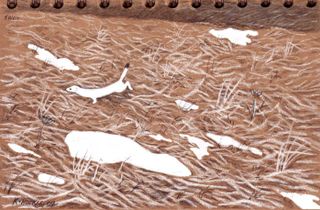 On a walk yesterday, 1000 feet elevation. Little grainy patches of snow were all that remained from last weekend's snowfall, and the bog grasses/sedges were matted and glum. Wind was gusting, making alder leaves skitter across the road.
The ermine didn't skitter–it rippled, moving along the ground like a minnow along a streambed. I held my breath as it crossed a small meadow and dived into the gloom under a hemlock.
Then I walked on, with leaves skittering around my feet. This is my memory of that encounter.
Storms of Birds
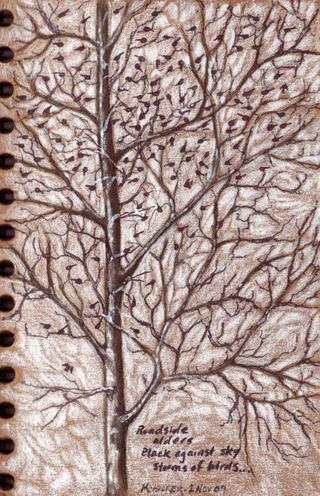 The Weather Service says we had a dry October, but that doesn't mean sunny. The days have been windswept, cold, and cloudy, for the most part. On my walks I've been watching the tops of the leafless alders, fascinated by the pattern of dark branches against shining sky.
It all looks so cold and lifeless… and then I'll walk past another tree and hundreds of small birds (siskins and probably redpolls too) will explode from the branches and swirl into the sky. They'll eddy for a moment like a river current, then descend to clutter the branches of the next alder. Then, as I approach, they'll take off again, all in unison so that hundreds of tiny, soft wing-claps merge into a great and startling "whump".
This sketch was inspired by those patterns of branches and birds. I haven't quite got the gestures of the alder branches, but I think it captures some of that restless motion.
Willow Ptarmigan
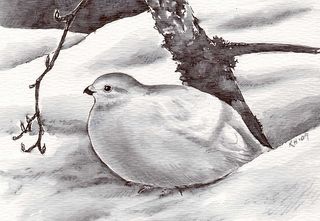 My trip to Bethel got me thinking about ptarmigan. The school district media center happened to have two very nicely taxidermied winter-plumage birds, so the students and I drew them in several classes. The kids knew ptarmigan well–they are a popular game/subsistence birds out there.
Ptarmigan are also pretty common around Juneau; we have all three Alaska species (rock, white-tailed, and willow), with rock and willow being the most abundant here. Willows are lower-elevation birds in general. They like deciduous thickets. I’ve often followed their soft, snowshoed tracks among the blueberry bushes behind my house. Every once in a while, I see one. It’s always a special occasion. They’re so trim and white and neat, with those sharp small black beaks and bright black eyes.
This sketch is based on a photo by my naturalist/photographer friend Bob Armstrong.
Tundra Morning
 Big gap in postings because I have been in Western Alaska, doing sketching classes with students of the Lower Kuskokwim School District. I didn't have time to do much sketching in my own book (most of my drawings were big ones, done as examples for the classes). But I did get out one morning for a walk on the tundra. The landscape is so flat, and there is so much water: tundra pools and sloughs, ponds, lakes, and the big Kuskokwim River and its side-channels. Dry land is a thin layer of grass and willow brush, pressed from above and below by sky and water. While I was there, freeze-up began…leaves of ice creeping almost visibly fast across the ponds…
Otter Skull
 Watched a river otter rollicking along the beach stones and it reminded me of a sketch page from last spring, when I had a good chance to look closely at a skull. One of the most interesting things about it was the very simply-shaped incisor teeth, when compared with those of a dog. Dogs' incisors are three-lobed and fairly robust, while river otters' are simple, straight, and almost delicate. I suppose otters don't do very much "dissection" nibbling of prey; they swallow a lot whole… but they do groom themselves, surely as much as dogs… Hmm…
 Katherine Hocker