Island Naturalists

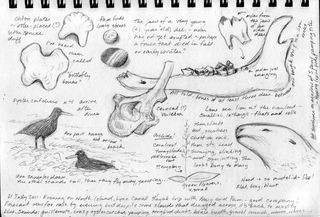
Hocker-kayak-trip-sketch- Spent a blissful three days puttering around Benjamin and North Islands with two naturalist friends. Kayaking and exploring conditions couldn't have been better: warm, sunny days with glassy water, cooler breezy evenings, lovely sunsets, few biting insects. Most importantly, we were surrounded by a paradise of nature puzzles and treasures to discover. Here's a first page of sketches; I'm planning a second page of memory sketches and notes and plan to post it soon.

UPDATE: looks like our mystery orchid is Malaxis (Hammerbya) paludosa, bog adder's-mouth orchid.
View from the Mountain

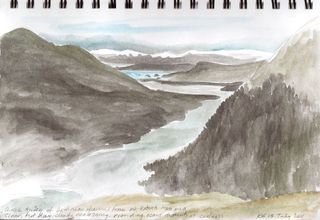
Hocker-mountain-sketch Went up Mount Roberts today–the view is gorgeous though a little surreal: because I went up on the tram I didn't have that feeling of pain-earned and endorphin-fueled accomplishment one usually gets from climbing 1000 feet up that steep trail.

I had sketchbook and a variety of supplies; I wanted to do a very fast watercolor sketch (10 min) of the view down Gastineau Channel. Decided to play with the metallic watercolors, which I hadn't done in a while. I like the earthiness of them.

When it came time to add the human elements in the lower left (bridge, harbor, town), I totally lost interest…Ah well.

Fringe benefits

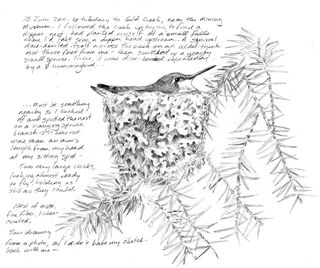
Hocker-hummingbird-sketch An expedition in search of dippers had me scrambling through devils-club and alder tangle, up a steep, fast-moving creek above Juneau. The dippers kept zinging upstream past me with food, so I knew the nest was even higher. Just about the point where I decided it wasn't worth six million more devils-club stabs and the risk of spraining some valuable joint, I sat  down for one more vigil. I never did see the dippers, but while I waited, this rufous hummingbird (Selasphorus rufus) nest was revealed to me–a great example of the fringe benefits of keeping still and paying attention.

The sketch is from a photo, as I had my camera but not my sketchbook…

Oystercatcher Morning

Hocker-oystercatcher-sketches

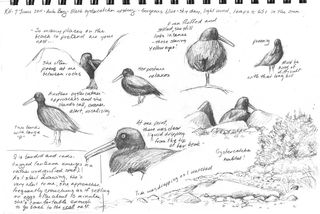
Hocker-oystercatcher2 Spent a pleasant couple of hours yesterday morning on a small island in Auke Bay, observing a pair of black oystercatchers (Haematopus bachmani) at their nest site. I especially enjoyed watching the different behaviors of the female and the male. The female was very vocal, stood and walked tall when in motion, moved around a great deal. The male crept among the rocks, keeping his head low, and sat still for many minutes at a time. The female was the one to settle on the nest, though.

The scrape nest held three eggs, just at the edge of the ryegrass zone, green with black speckles and very hard to see. It was an eloquent case for being very careful when exploring the shore this time of year–and perhaps just avoiding this type of habitat altogether and staying below the tideline…


UPDATE: I have just learned that the tagged bird is actually a male, so the above-described behaviors should be role-reversed… This male was banded and satellite-tagged about four years ago. He has been returning to the same nesting area ever since. 

Dipper Watching

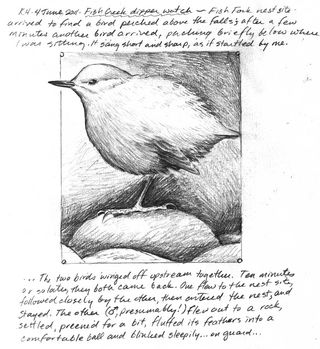
Hocker-dipper-sketch-2 I've been assisting with research on American Dippers in the Juneau area for eight years now, and have co-authored a couple of books about them. I just never get tired of watching these great little birds–they're endlessly entertaining! Went out a couple of days ago to check on a nest site and found a pair busy establishing the next generation. Like most dippers, they've chosen fantastic real estate: the nest is tucked among some boulders behind a small but beautiful waterfall. Didn't have my sketchbook with me, so this drawing is from memory.

For more information about our books about American Dippers, see my books page.

Cabin weekend

Cabin-sketch-kh Spent a few days in Gustavus, doing some maintenance on the cabin. I don't draw buildings very much… the porch roof was particularly challenging, especially from this angle…

Estuary Birds

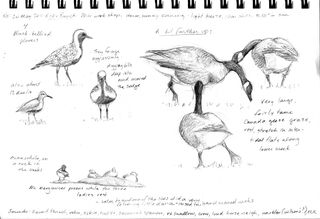
Hocker-cowee-sketch Spent the weekend at a women's outdoor-skills workshop, held at a camp at the mouth of Cowee Creek. Cowee is an incredibly rich system–fed by glacial and meltwater streams, flowing down through spruce lowlands and out through a mosaic of uplift meadows, spruce groves, alder and willow thickets, and lovely oozy sedge-filled estuary. An hour with a spotting scope gave me plenty of material for bird sketches…

Unalakleet visit, part 5

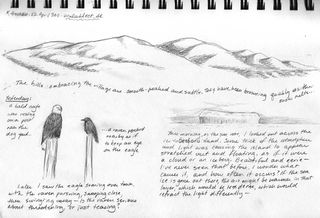
Unk-sketch-6 Here's another sketch page from Unalakleet. I could see these hills from my window, and wanted to try to capture their smooth rhythm, and the way the trees and brush huddle in the ravines. That took care of the top of the page… then I went for a walk on the road out of town and spotted the eagle/raven dynamic. Finally, the last morning I was teaching, there was an inversion layer that caused phenomenal optical illusions, including this view of Besboro Island across Norton Sound.

Unalakleet visit, part 4

Unk-sketch-5 The weekend of the ski picnic was sunny and warm, and lots of people were up the river ice fishing. A kind local teacher took me to several different sites. It was a pleasure to see a grayling again; they're very rare in Southeast (just a couple of remote lakes where they were planted), and they are so lovely: iridescent purples, greens, and blues, and that extravagant dorsal fin like a furled sail.

Unalakleet visit, part 3

Unk-sketch-4 On the ski picnic, I collected some branches of white spruce (Picea glauca) and felt-leaf willow (Salix alaxensis) that had been cut during the festivities. The willows in particular were interesting. The tips of many of the branches were as densely-furred as hares' feet, making them shine and sparkle as if frost-covered. Within a day of my bringing this branch in and putting it in water, the catkins were swelling dramatically, shoving the protective scales off at the tips–a process that's listed as one diagnostic characteristic of this species.