 On the island of Chiloe, the forests were aflame with the bright red blossoms of notro trees. Firecrown hummingbirds, cometocino finches, blackbirds, and others were busy with the very nectar-rich flowers. Like hummingbirds everywhere, the firecrowns defended the trees fiercely.
Tag Archives: sketchbook
Chile, Part 4
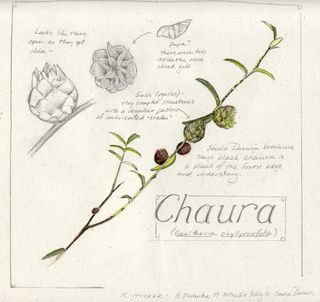 The island of Chiloe, in the south of the country, is an extraordinary place, with a highly-diverse forest, great variety of birds, and a mellow, friendly atmosphere. It was our favorite place; I'd gladly go back there for more seafood, hiking, birdwatching, and exploring.
Chaura was one of dozens of native forest species there. It's a Gaultheria, so it's closely related to wintergreen (procumbens) and salal (shallon). I got fascinated by the beautiful galls on many of the chaura bushes, so here's my page about them.
For some photos of Chiloe (and the other parts of our trip) go to the following URL: http://www.flickr.com/photos/46117111@N05/sets/72157623005731457
Chile, Part 3
 One of the pleasures of going somewhere altogether new is seeing so many new birds. Even "ordinary" birds–the ones that everyone there is numbly familiar with, the ones analogous to crows or robins or mallards here–have an exotic appeal. Six days of enforced beach leisure, surrounded by all these "new" birds gave me plenty of opportunity to observe their habits and sketch them. Of the birds on this page, Franklin's gulls, neotropic cormorants, American oystercatchers, and whimbrels make their way to latitudes where I've seen them. The rest were brand-new to me…
And I'll put in a plug here for Jaramillo's terrific book Birds of Chile. Great illustrations, well-written, easy to use.
Chile, Part 2
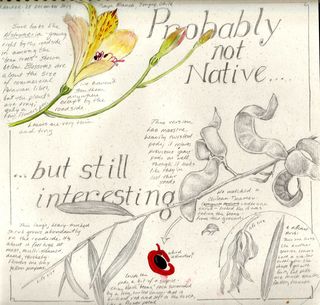 Here are a couple of plants we found on a walk. Because they grew in close proximity to roads and buildings, I assumed they must be introduced. But after researching them a bit, I'm now thinking they might be more native than I had thought. There are many native Alstroemerias in Chile (although apparently most are winter-blooming), and the legume shrub looks like it could be in the Prosopis genus, which is native… in any case, I was intrigued by that odd, bright red flag on the seed. Cheryl wondered if it was a bird-attractor.
Soft Sky Day
 We've had quite a bit of snow lately, most of it falling in long, relentless storms of tiny flakes: the kind of snowstorm that softens the edges of not only the physical world but also the world of sound, and, somehow, the province of emotion.
For some reason, ravens seem to be exceptions to that blankness; their silhouettes nearly as sharp as on a clear day, their calls and the rattle of their wings as carrying, their characters as substantial. It's as if they are drawing all the world's crispness into themselves as a joke, leaving the rest of us to drift around, muffled and half-present while they chuckle.
Contorta contorta, Part 2

In my opinion, no other trees in Southeast Alaska are as suffused with sheer character as shore pines (Pinus contorta contorta). Over hundreds of years, they grow into an incredible variety of shapes, pressed and bent and corkscrewed by snow and wind and time.
Then, after they live out their multi-century lives and begin to decompose, their unique characters emerge even more strongly. Most have twisted trunks (according to a small study a friend and I did last winter, almost all trunks twist to the right). Some, like this one, twist in incredibly tight spirals, while others are more relaxed. Over time, they begin to look less like tree trunks and more like frayed and rotting ropes, their fibers gone soft and silver.
Storms of Birds
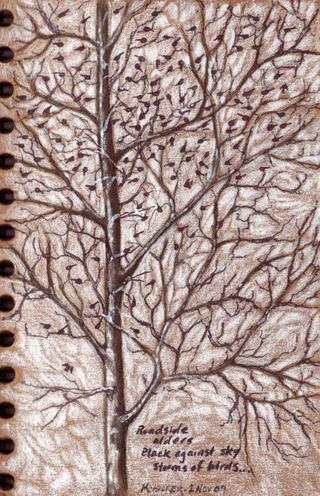 The Weather Service says we had a dry October, but that doesn't mean sunny. The days have been windswept, cold, and cloudy, for the most part. On my walks I've been watching the tops of the leafless alders, fascinated by the pattern of dark branches against shining sky.
It all looks so cold and lifeless… and then I'll walk past another tree and hundreds of small birds (siskins and probably redpolls too) will explode from the branches and swirl into the sky. They'll eddy for a moment like a river current, then descend to clutter the branches of the next alder. Then, as I approach, they'll take off again, all in unison so that hundreds of tiny, soft wing-claps merge into a great and startling "whump".
This sketch was inspired by those patterns of branches and birds. I haven't quite got the gestures of the alder branches, but I think it captures some of that restless motion.
Tundra Morning
 Big gap in postings because I have been in Western Alaska, doing sketching classes with students of the Lower Kuskokwim School District. I didn't have time to do much sketching in my own book (most of my drawings were big ones, done as examples for the classes). But I did get out one morning for a walk on the tundra. The landscape is so flat, and there is so much water: tundra pools and sloughs, ponds, lakes, and the big Kuskokwim River and its side-channels. Dry land is a thin layer of grass and willow brush, pressed from above and below by sky and water. While I was there, freeze-up began…leaves of ice creeping almost visibly fast across the ponds…
Otter Skull
 Watched a river otter rollicking along the beach stones and it reminded me of a sketch page from last spring, when I had a good chance to look closely at a skull. One of the most interesting things about it was the very simply-shaped incisor teeth, when compared with those of a dog. Dogs' incisors are three-lobed and fairly robust, while river otters' are simple, straight, and almost delicate. I suppose otters don't do very much "dissection" nibbling of prey; they swallow a lot whole… but they do groom themselves, surely as much as dogs… Hmm…
Yellow Pond Lily

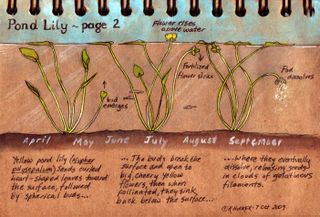 Spent a fair bit of time today wandering around a medium-elevation bog. Plants were about the same stage as those at sea level, though a couple of pond lilies still had underwater buds (!) This was particularly interesting, because I could see almost all of the stages of flowering at once. I had never studied their blooming cycle that closely. I was fascinated at how the pods dissolve in the still, tea-colored water of the bog ponds; I could see scatterings of seeds underneath several plants.
I always feel a little guilty picking a pond lily flower or seedpod. They're so big, and so gracefully-formed: like urns or chalices. But there were so many this summer that I'm not feeling too terrible about it. Several of my plant books say the seeds are edible and tasty. I'd say edible, perhaps borderline tasty. They're big, anyway: as big as grains of Calrose rice.
 Katherine Hocker