Contorta contorta, Part 2

Twisted-pine

In my opinion, no other trees in Southeast Alaska are as suffused with sheer character as shore pines (Pinus contorta contorta). Over hundreds of years, they grow into an incredible variety of shapes, pressed and bent and corkscrewed by snow and wind and time.

Then, after they live out their multi-century lives and begin to decompose, their unique characters emerge even more strongly. Most have twisted trunks (according to a small study a friend and I did last winter, almost all trunks twist to the right). Some, like this one, twist in incredibly tight spirals, while others are more relaxed. Over time, they begin to look less like tree trunks and more like frayed and rotting ropes, their fibers gone soft and silver.
Storms of Birds

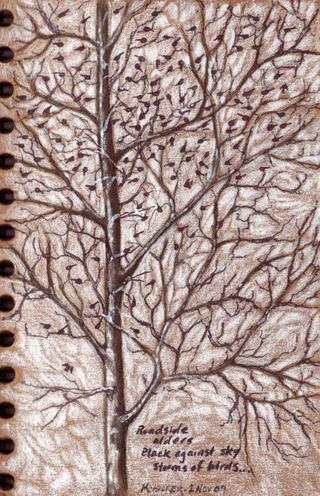
Birdstorm2 The Weather Service says we had a dry October, but that doesn't mean sunny. The days have been windswept, cold, and cloudy, for the  most part. On my walks I've been watching the tops of the leafless alders, fascinated by the pattern of dark branches against shining sky.

It all looks so cold and lifeless… and then I'll walk past another tree and hundreds of small birds (siskins and probably redpolls too) will explode from the branches and swirl into the sky. They'll eddy for a moment like a river current, then descend to clutter the branches of the next alder. Then, as I approach, they'll take off again, all in unison so that hundreds of tiny, soft wing-claps merge into a great and startling "whump".

This sketch was inspired by those patterns of branches and birds. I haven't quite got the gestures of the alder branches, but I think it captures some of that restless motion.

Willow Ptarmigan

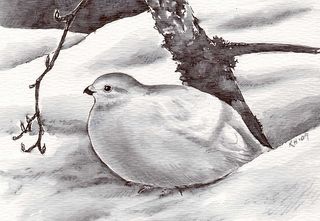
PtarmiganMy trip to Bethel got me thinking about ptarmigan. The school district media center happened to have two very nicely taxidermied winter-plumage birds, so the students and I drew them in several classes. The kids knew ptarmigan well–they are a popular game/subsistence birds out there.

Ptarmigan are also pretty common around Juneau; we have all three Alaska species (rock, white-tailed, and willow), with rock and willow being the most abundant here. Willows are lower-elevation birds in general. They like deciduous thickets. I’ve often followed their soft, snowshoed tracks among the blueberry bushes behind my house. Every once in a while, I see one. It’s always a special occasion. They’re so trim and white and neat, with those sharp small black beaks and bright black eyes.

This sketch is based on a photo by my naturalist/photographer friend Bob Armstrong.

Tundra Morning

Tundra-morning   Big gap in postings because I have been in Western Alaska, doing sketching classes with students of the Lower Kuskokwim School District. I didn't have time to do much sketching in my own book (most of my drawings were big ones, done as examples for the classes). But I did get out one morning for a walk on the tundra. The landscape is so flat, and there is so much water: tundra pools and sloughs, ponds, lakes, and the big Kuskokwim River and its side-channels. Dry land is a thin layer of grass and willow brush, pressed from above and below by sky and water. While I was there, freeze-up began…leaves of ice creeping almost visibly fast across the ponds…

Otter Skull

Otterskull Watched a river otter rollicking along the beach stones and it reminded me of a sketch page from last spring, when I had a good chance to look closely at a skull. One of the most interesting things about it was the very simply-shaped incisor teeth, when compared with those of a dog. Dogs' incisors are three-lobed and fairly robust, while river otters' are simple, straight, and almost delicate. I suppose otters don't do very much "dissection" nibbling of prey; they swallow a lot whole… but they do groom themselves, surely as much as dogs… Hmm…

Yellow Pond Lily

Pond-lily1-kh

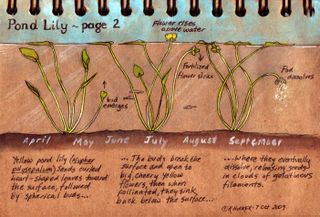
 Pond-lily2-khSpent a fair bit of time today wandering around a medium-elevation bog. Plants were about the same stage as those at sea level, though a couple of pond lilies still had underwater buds (!) This was particularly interesting, because I could see almost all of the stages of flowering at once. I had never studied their blooming cycle that closely. I was fascinated at how the pods dissolve in the still, tea-colored water of the bog ponds; I could see scatterings of seeds underneath several plants.

I always feel a little guilty picking a pond lily flower or seedpod. They're so big, and so gracefully-formed: like urns or chalices. But there were so many this summer that I'm not feeling too terrible about it. Several of my plant books say the seeds are edible and tasty. I'd say edible, perhaps borderline tasty. They're big, anyway: as big as grains of Calrose rice.

Bog Pods

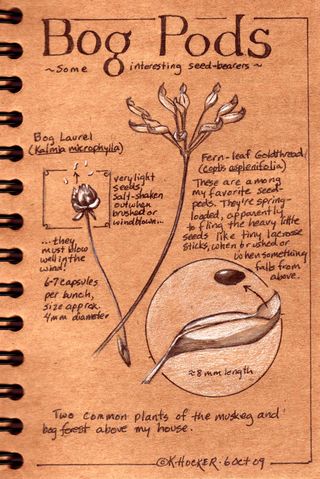
Bog-pods-kh Everything's going to seed these days… all those unpicked blueberries are bloated with rain and tasteless now, bursting and spattering their little seeds onto the vegetation below, menziesia pods drying and curling, and these two bog/wet forest plants whose seed capsules I find particularly enchanting-looking…

Sea and Sky in Hoonah

Hoonah-beach-kh

Spent yesterday in Hoonah at what used to be Cannery Point; now a tour destination with restored cannery buildings housing cafes, exhibits, and souvenir shops. It was warm for September, with cloud-chased sunshine and occasional stutters of rain. Port Frederick was so calm, so quiet that we could easily hear the breath of a lone humpback whale in the distance…and, every so often, the thrilling calls of the sandhill cranes skeining overhead.

Autumn Storm and Autumn Fruits

Late-berries

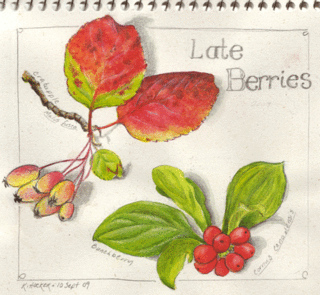
Northern Southeast Alaska was battered by a muscular Pacific storm yesterday– all eerie light and buffeting wind, with purple-gray swaths of rain hitting Stephens Passage so hard that the ocean water seemed to be jumping up to meet them in mid-air. I walked through the storm to the beach, listening to the wind moan and hiss. Collected these late fruits on the way back. Crabapples are among the few native shrubs here that show any fall color; in yesterday's wind their leaves were spinning on the branches, flashing red and orange, flying through the air like bonfire sparks. Down below, bunchberries hugged the ground, slick with rain.

Abby

Abby

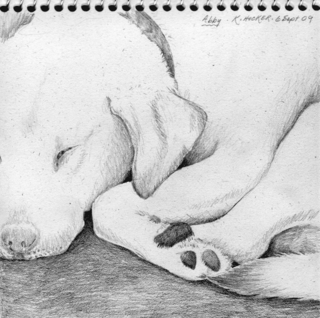
Abby was a "problem dog" (she liked to wander, and wouldn't come when called). Some friends adopted her from the local animal shelter last fall. Now that she gets enough exercise and training, she's becoming a model canine citizen. I love her big, broad Labrador head; like the head of a seal. I enjoyed doing this sketch–I wanted to capture the way she curled so snugly into a sleepy, contented bundle.