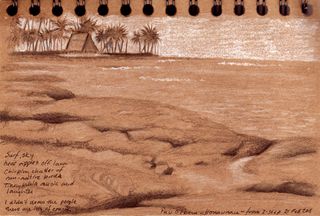
 Just got back from a vacation on the island of Hawaii (Big Island). Being ocean people, we spent most of it in the water or directly adjacent. One of the loveliest places we visited was Pu'uhonua o Honaunau National Historical Park, south of Kealakekua Bay on the west coast. Spent the morning alternately snorkeling and sketching, looking across the lava shelf to the serene palms of the park.
Tag Archives: sketch
Owl Skull
 A friend found a barred owl (Strix varia), dead, in the woods. After a few months in contact with the busy soil critters, the bones were clean. I am fascinated by the double-domed shape of the cranium.
It's interesting to compare it to the skull in the owl sketch page I posted on my "classes" page. I think that one's a great horned owl. This one is smaller, a bit more delicate, with a shorter bill. Also, the frontal bone (just above the beak) of the barred owl is much less swollen-looking than that of the great horned/great gray owl.
Hungry for Spring
 I caught myself thinking this morning, In just a month, we'll be hearing varied thrushes… in just two months, we might be starting to work the soil in the garden beds… in just three months, the little lilies will be blooming… It's that time of year when I struggle to appreciate what's here rather than just longing for what's coming.
So the compromise is to look at seed capsules and buds. Rusty menziesia is a good example; its handsome little capsules are gaping wide this time of year, its seeds long gone, and the buds are sharp and tight and just touched with rusty color. They're late-openers around here, though–it won't be until long after the blueberry bells are out that these buds will open.
Deer Food
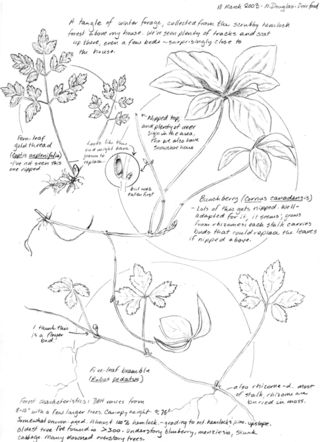 This one's a "vintage" page from several years ago. I set out to take a closer look at three plants that are considered critical winter food for Sitka black-tailed deer (Odocoileus hemionus), the little forest deer of Southeast Alaska.
In winter, when the more delectable plants are sleeping deciduously underground or buried beneath heavy snow, these three winter-greens tough it out on the floor of the broken-canopied hemlock/spruce forest.
We've been seeing a lot of deer lately near my home. The warm sunny spring/early summer has coaxed bursts of ridiculously lush greenery out along the roadsides and beaches. Happy deer…
Otter-bahn
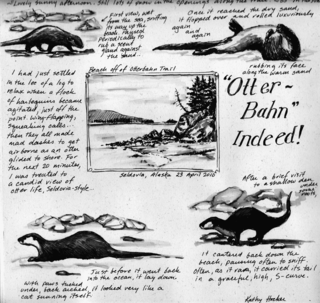 Here's a page of sketches from my recent stay in Seldovia, where I spent a couple of wonderful weeks as artist-in-residence. The school is very small (50 kids K-12) so I got to work with every student, every day.Great kids, great teachers, great staff, nice community… thanks, Seldovia!
One evening, I walked out the "Otterbahn" trail (constructed by a group of high school students in the 1990s, I think) to a small beach. As I settled down to sun and sketch, I heard harlequin ducks making agitated noises. The ducks huffed and squeaked, then finally took off just as a big otter rounded the point. He climbed ashore, shook himself off, and proceeded to entertain me for about twenty minutes, as this page attests.
Chile, part 5
 On the island of Chiloe, the forests were aflame with the bright red blossoms of notro trees. Firecrown hummingbirds, cometocino finches, blackbirds, and others were busy with the very nectar-rich flowers. Like hummingbirds everywhere, the firecrowns defended the trees fiercely.
Chile, Part 4
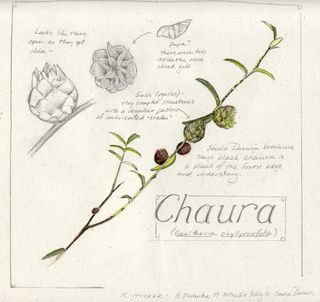 The island of Chiloe, in the south of the country, is an extraordinary place, with a highly-diverse forest, great variety of birds, and a mellow, friendly atmosphere. It was our favorite place; I'd gladly go back there for more seafood, hiking, birdwatching, and exploring.
Chaura was one of dozens of native forest species there. It's a Gaultheria, so it's closely related to wintergreen (procumbens) and salal (shallon). I got fascinated by the beautiful galls on many of the chaura bushes, so here's my page about them.
For some photos of Chiloe (and the other parts of our trip) go to the following URL: http://www.flickr.com/photos/46117111@N05/sets/72157623005731457
Chile, Part 3
 One of the pleasures of going somewhere altogether new is seeing so many new birds. Even "ordinary" birds–the ones that everyone there is numbly familiar with, the ones analogous to crows or robins or mallards here–have an exotic appeal. Six days of enforced beach leisure, surrounded by all these "new" birds gave me plenty of opportunity to observe their habits and sketch them. Of the birds on this page, Franklin's gulls, neotropic cormorants, American oystercatchers, and whimbrels make their way to latitudes where I've seen them. The rest were brand-new to me…
And I'll put in a plug here for Jaramillo's terrific book Birds of Chile. Great illustrations, well-written, easy to use.
Chile, Part 2
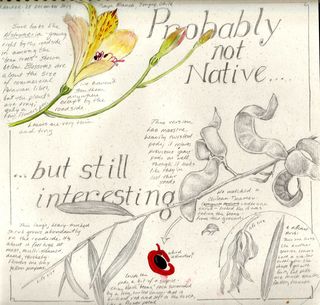 Here are a couple of plants we found on a walk. Because they grew in close proximity to roads and buildings, I assumed they must be introduced. But after researching them a bit, I'm now thinking they might be more native than I had thought. There are many native Alstroemerias in Chile (although apparently most are winter-blooming), and the legume shrub looks like it could be in the Prosopis genus, which is native… in any case, I was intrigued by that odd, bright red flag on the seed. Cheryl wondered if it was a bird-attractor.
Soft Sky Day
 We've had quite a bit of snow lately, most of it falling in long, relentless storms of tiny flakes: the kind of snowstorm that softens the edges of not only the physical world but also the world of sound, and, somehow, the province of emotion.
For some reason, ravens seem to be exceptions to that blankness; their silhouettes nearly as sharp as on a clear day, their calls and the rattle of their wings as carrying, their characters as substantial. It's as if they are drawing all the world's crispness into themselves as a joke, leaving the rest of us to drift around, muffled and half-present while they chuckle.
 Katherine Hocker