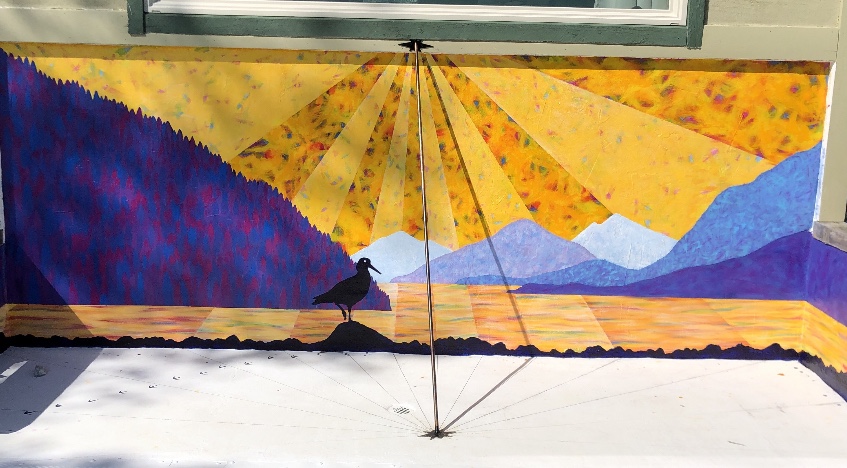
A couple of years ago, my friends Kim and Wayne asked me to paint a mural on their house. They had built a small greenhouse, then decided they didn’t want it anymore. They disassembled it, leaving an empty roofless alcove on the house’s outside south wall.
They didn’t have any strong feelings about what the mural would consist of, so I spent way too long pondering what to paint. They’re both avid sea kayakers, so I thought it would be nice to include some representation of the kayaking experience—maybe a beach scene with various critters?
Then one day I had an idea. The mural alcove faces due south, and their house has almost 360 degree sun exposure. How about a mural that would function as a sundial? I proposed it, and they liked the idea.
Next: what style of sundial would work best here? There are many choices! After researching, my favorite options were:
1. A horizontal style, which is what a lot of folks (including me) picture when they hear “sundial.” An angled gnomon sticks upward, casting a moving shadow across a horizontal surface.
2. A vertical style, with the angled gnomon mounted on a wall; the shadow travels across the wall below.
Pretty quickly I realized that these two are not mutually exclusive. If we used an angled bar, attached at both ends, as the gnomon, we would have both types of sundial in one. That approach seemed like it would suit the space well: a rocky shoreline scene, giving the effect of relaxing on the beach and watching wildlife, with hour markings designed into the scenery on the wall and floor.
Wayne got very interested in the process, and while I refined the mural design, he dug into gnomon planning and construction. He made the gnomon from a length of pipe, and forged two decorative brackets out of steel. After considerable research, many compass bearings, and night-time sightings on Polaris, he found the correct angle and bearing to mount it.
That was last summer. Since then, all of us have been watching the shadows and marking the hours. In the process, we discovered that sundial (solar) time doesn’t exactly match clock time! This has to do with the Earth’s elliptical orbit around the sun; the speed of the sun’s apparent motion across the sky is different at different times of the year. We witnessed this firsthand last winter when the shadows were as much as 10-15 minutes off the marks we’d made in late summer. Some sundials have adjustments to account for this discrepancy, but we decided to just embrace solar time.
This summer I started painting. The sundial spot is not covered, so I’ve had to wait for dry days, but fortunately we’ve had a few good sunny spells lately. It’s been a treat to watch the shadow crawl across the mural as I work, and it has been really satisfying to watch it keep time.
I finished the background on the vertical wall a couple of weeks ago. Last week, just in time for Solstice, I started adding the bird-silhouette hour markers. On each solar hour, the gnomon shadow will pass across the eye of a bird. The first bird I added is a favorite of Kim and Wayne’s: a black oystercatcher (lugán in Lingít). It’s at the noon hour.
13 more birds to go, and then I need to tackle the horizontal sundial on the floor!
 Katherine Hocker